
The WhatsApp Automation Stack Is Broken. Businesses Need an Operating Layer.
Why connecting WhatsApp to your business isn't enough anymore.
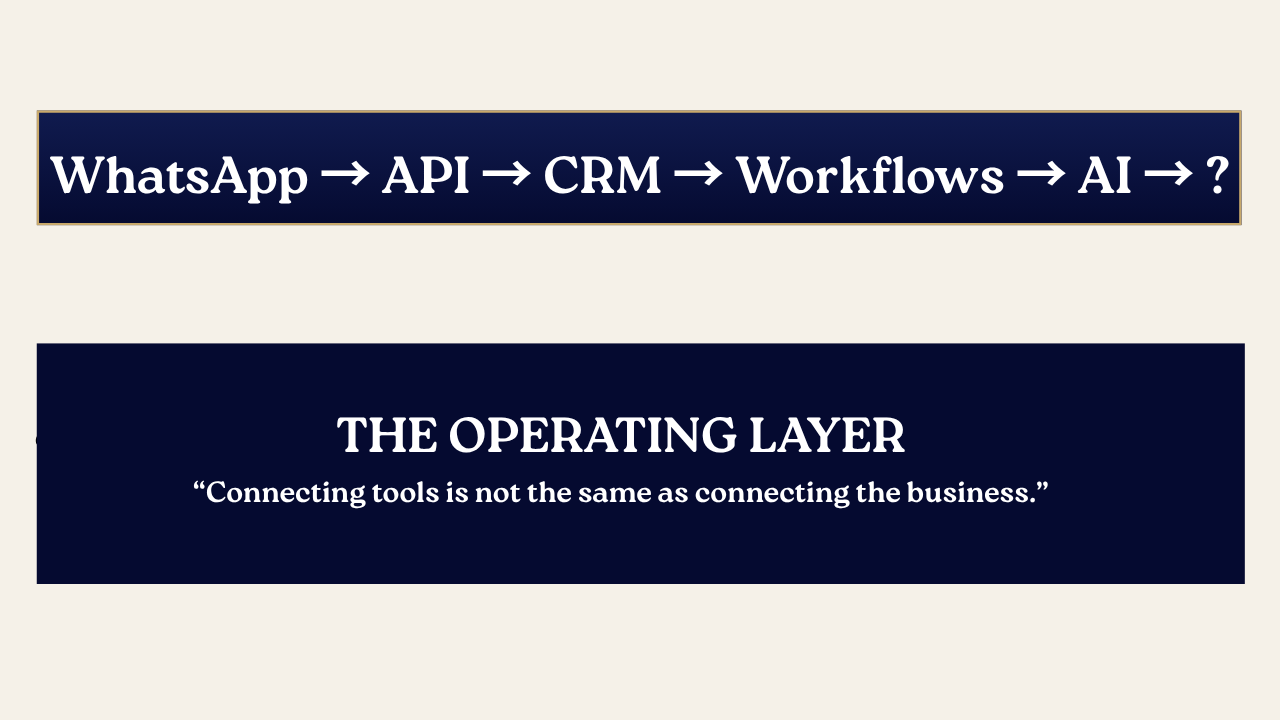
There was a time when getting your business on WhatsApp was the innovation.
Then came the WhatsApp API.
Then chatbots.
Then CRM integrations.
Then automated follow-ups.
Then AI.
And somehow, businesses ended up with more automation - but not necessarily more control.
A lead comes in through WhatsApp.
It gets pushed into a CRM.
A workflow triggers a message.
Another tool handles the follow-up.
Someone checks the conversation manually.
Another system handles the booking.
And somewhere in between all of this, the customer is still waiting for an answer.
The tools are connected.
The business isn't.
That's the real problem with the current WhatsApp automation stack.
The API Solved Messaging. It Didn't Solve the Business.
WhatsApp APIs made something incredibly important possible:
Businesses could finally communicate with customers at scale.
But sending a message is only one part of a customer interaction.
A business also needs to know:
Who is this customer?
What do they want?
How valuable is this lead?
What happened earlier in the conversation?
What should happen next?
When should we follow up?
Should we book, qualify, recover, escalate, or close?
The API can help you move the message.
It doesn't make the decision.
And that's where the next layer of WhatsApp automation begins.
1. Your Business Doesn't Need More Workflows. It Needs Context.
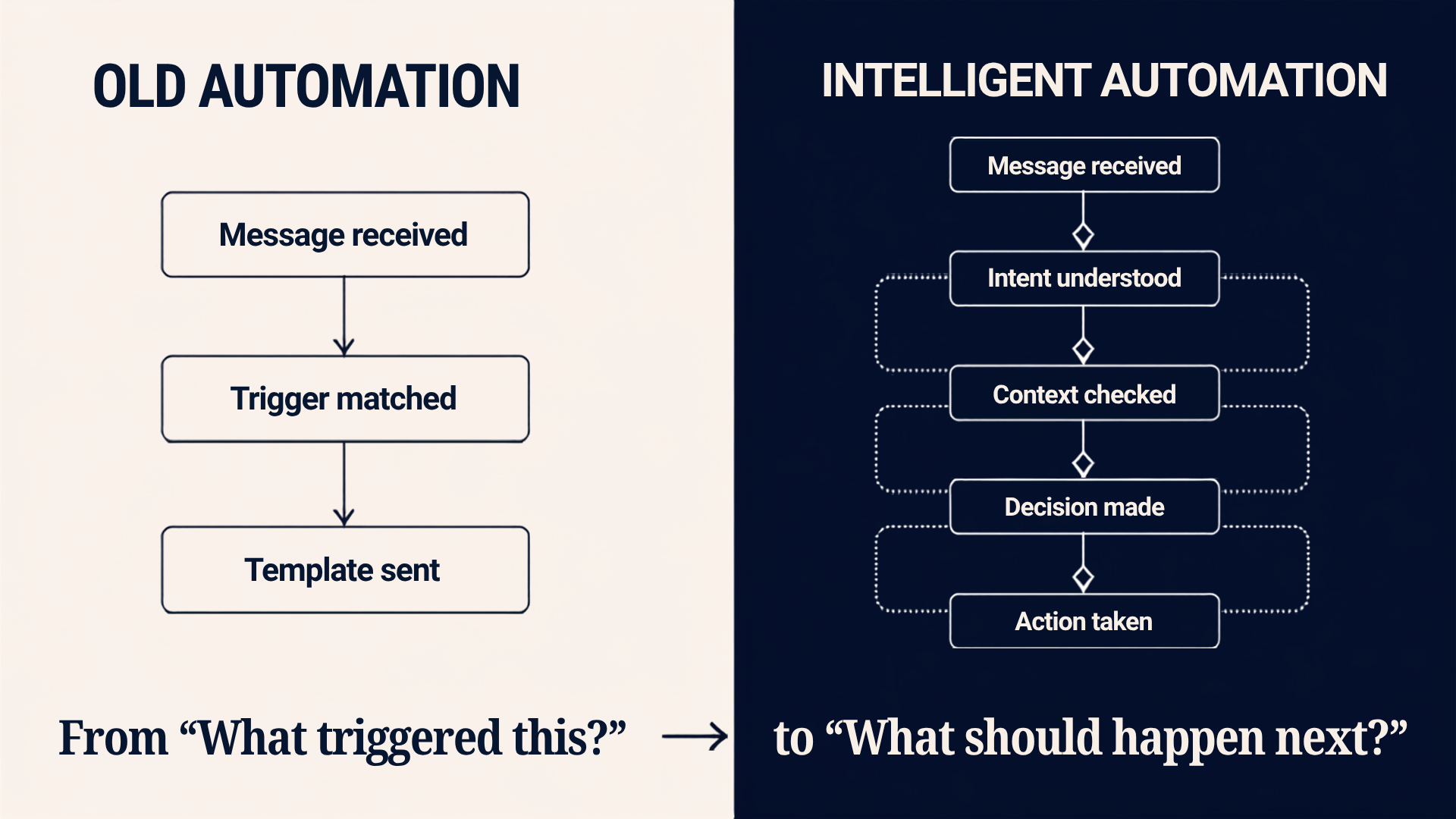
Here's what traditional automation usually looks like:
IF a lead submits a form
→ THEN send a WhatsApp message.
IF customer doesn't reply
→ THEN send a follow-up.
IF order is placed
→ THEN send confirmation.
Useful?
Absolutely.
Enough?
Not anymore.
Because real customer conversations aren't made of simple yes/no triggers.
A customer might say:
“I'm interested, but I need to check with my partner.”
Another might say:
“Can you deliver by Friday?”
Another:
“I bought this last month. It's not working.”
Another:
“I need something for 50 people.”
These conversations require understanding, not just triggering.
The next generation of automation needs to understand the context behind the message before deciding what to do next.
That's the difference between:
Workflow automation
and
intelligent business automation.
2. The Problem Isn't That Businesses Have Too Few Tools.
It's that every tool knows only one part of the story.
Your CRM knows the lead.
Your WhatsApp platform knows the conversation.
Your booking system knows the appointment.
Your e-commerce platform knows the order.
Your payment system knows the transaction.
Your support team knows the complaint.
But the customer doesn't experience these as separate systems.
They experience one conversation with your business.
And that's where fragmented automation starts becoming a problem.
Imagine a customer who has already spoken to your sales team.
They've explained their requirements.
They've shared their budget.
They've asked for a callback.
And then an automated bot asks:
“Hi! How can we help you today?”
That's not automation.
That's amnesia at scale.
The customer shouldn't have to repeat themselves because your systems don't share context.
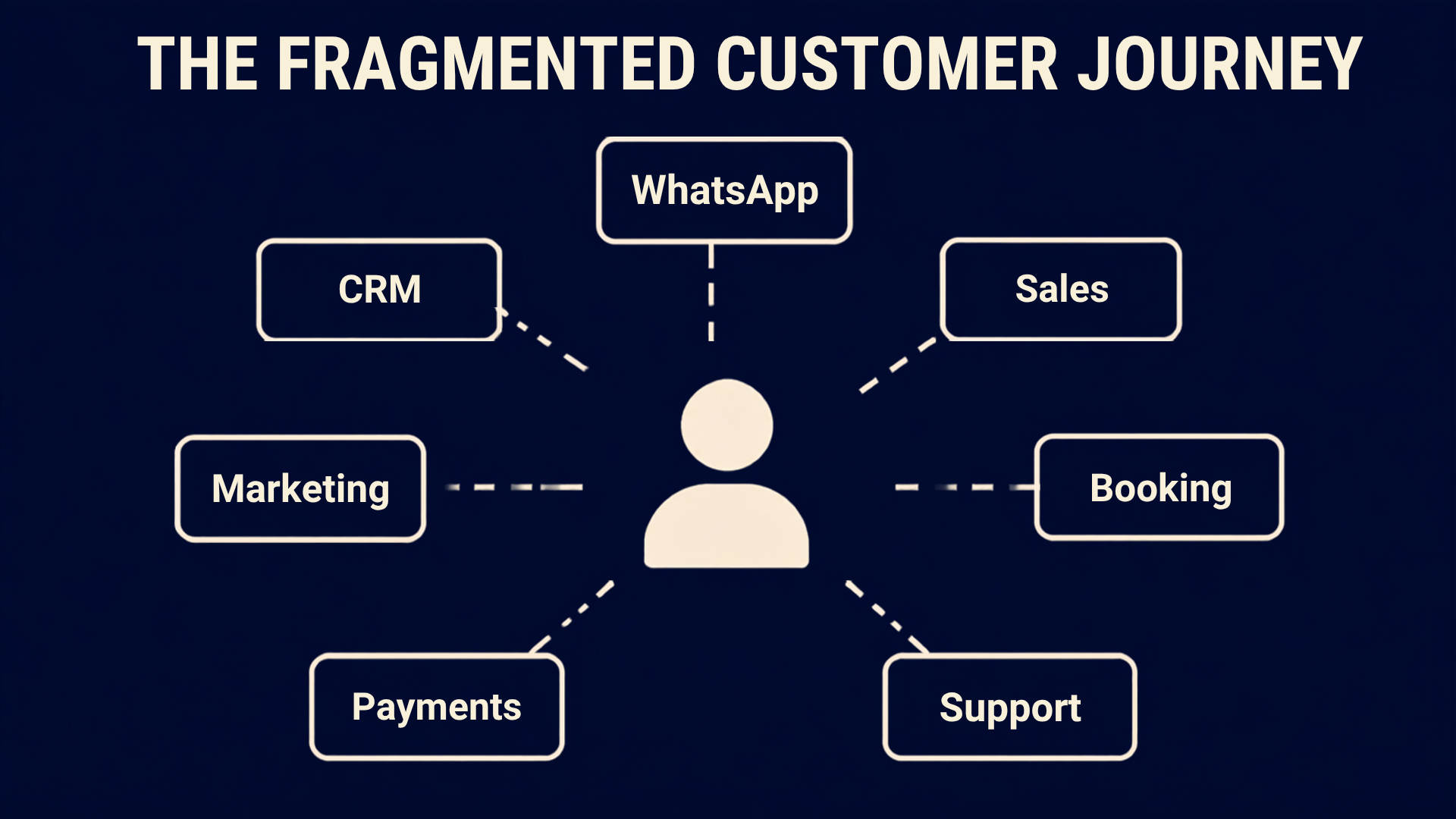
Customer sees one conversation.
Your business sees seven systems.
This should be a very strong conceptual graphic.
3. The Future Isn't “Automate Every Step.”
It's “Give the System Enough Intelligence to Handle the Journey.”
Think about what happens after a lead sends:
“I'm interested.”
Traditional automation asks:
Which workflow should I trigger?
A smarter system asks:
What is this person actually trying to accomplish?
Maybe they're ready to buy.
Maybe they want pricing.
Maybe they're comparing options.
Maybe they're asking for availability.
Maybe they're just exploring.
The response shouldn't be identical.
Because intent changes the next action.
A high-intent buyer might need a sales handoff.
A customer asking for availability might need a booking flow.
A confused customer might need information.
A dormant lead might need re-engagement.
The goal isn't to automate the conversation.
The goal is to automate the decision-making around the conversation.
4. This Is Where AI Agents Change the Architecture.
Chatbots were designed around:
Question → Answer
Workflows were designed around:
Trigger → Action
AI Agents introduce something more powerful:
Intent → Reasoning → Decision → Action
An agent can understand what the customer wants, use the information available to it, and determine the appropriate next step.
That could mean:
Qualifying a lead
Answering a product question
Checking availability
Booking an appointment
Following up with an interested customer
Recovering an abandoned conversation
Re-engaging an old customer
Escalating a complex issue
Updating a business system
The important part isn't that all of this happens automatically.
It's that the system can decide what needs to happen next.
5. An Operating Layer Sits Above the Tools.
This is the missing piece.
Your business already has systems.
You don't necessarily need another dozen disconnected tools.
You need a layer that can orchestrate what happens between them.
Think of it this way:
Your existing stack
WhatsApp
CRM
Website
Payments
E-commerce
Booking
Lead sources
↓
Operating Layer
Understand → Decide → Execute → Update
↓
Business Outcome
Lead → Conversation → Conversion
Or:
Customer → Support → Resolution
Or:
Customer → Booking → Reminder → Visit
The operating layer isn't replacing every system.
It's making the systems work together around the customer.
6. The Real Unit of Automation Isn't the Message.
It's the Outcome.
This is an important shift.
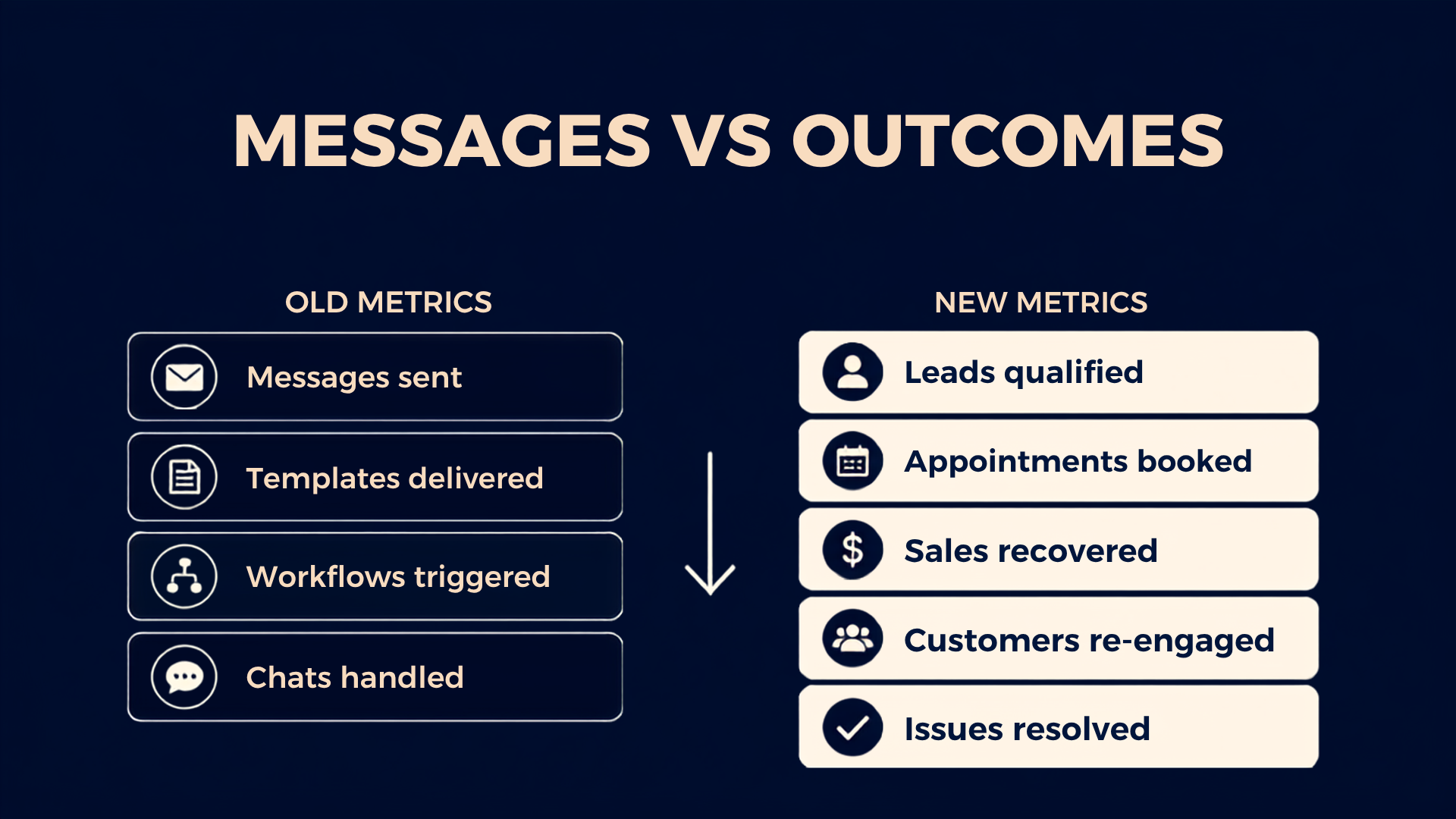
Businesses have traditionally measured automation by:
Messages sent.
Templates delivered.
Workflows triggered.
Conversations handled.
But businesses don't make money because they sent 10,000 messages.
They make money when those conversations produce outcomes.
A lead gets qualified.
A meeting gets booked.
A customer completes a purchase.
A missed opportunity gets recovered.
A customer comes back.
A support issue gets resolved.
That's why the real question shouldn't be:
“How many conversations did we automate?”
It should be:
“How many business outcomes did we automate?”
That's a fundamentally different way of thinking about WhatsApp.
7. This Matters Even More for SMBs.
Large companies can afford teams for sales, support, operations, CRM management, customer success and automation.
Most small and mid-sized businesses can't.
The same person might be:
Handling leads at 10 AM.
Following up at 12 PM.
Answering customer questions at 2 PM.
Checking orders at 4 PM.
And chasing missed leads at 7 PM.
For them, automation isn't about replacing people.
It's about giving a small team the leverage of a much larger operation.
Instead of adding another person every time customer conversations increase, businesses can build systems that handle repetitive decisions and actions automatically.
That changes the economics of growth.
More conversations don't have to mean proportionally more operational workload.
8. The Next WhatsApp Advantage Won't Be Who Sends the Fastest Message.
Everyone can send a WhatsApp message.
Everyone can create a chatbot.
Everyone can automate a follow-up.
The competitive advantage is moving somewhere else.
It's becoming:
Who understands the customer better?
Who responds with the right action?
Who follows up at the right moment?
Who connects conversations to business systems?
Who turns more conversations into measurable outcomes?
That is where WhatsApp automation is heading.
From a communication channel...
to a business execution layer.
Now it can become an operating layer.
Minimal black/navy background with cream typography and one subtle accent element.
9. So What Does the Modern WhatsApp Stack Look Like?
Not:
WhatsApp + API + 15 workflows + 6 disconnected tools.
Instead:
Customer Conversation
↓
Context
↓
AI Decision
↓
Business Action
↓
System Update
↓
Next Best Action
And the loop continues.
That's what makes automation truly intelligent.
It doesn't just execute a predefined sequence.
It continuously moves the customer journey forward.
10. This Is the Problem Nextel Is Built Around.
Nextel isn't built around the idea that businesses simply need another way to send WhatsApp messages.
The bigger opportunity is to make WhatsApp conversations operationally useful.
Nextel brings customer conversations, AI Agents, automation and business workflows into one connected layer.
So instead of building dozens of isolated automations, businesses can create systems that work around the customer's intent and the business outcome.
A lead doesn't just enter a workflow.
It enters a system that can understand what happens next.
A customer doesn't just receive an automated reply.
The conversation can trigger the right business action.
And a business doesn't just automate messages.
It can automate parts of the operation behind those messages.
The WhatsApp Automation Stack Isn't Going Away.
It's Evolving.
The first generation of WhatsApp automation was about:
Sending messages at scale.
The second was about:
Connecting workflows.
The next generation will be about:
Understanding intent, making decisions and executing business actions.
That's why businesses don't just need more automation.
They need an operating layer that connects conversations to outcomes.
Because the future of business messaging isn't:
More messages.
It's:
Better decisions. Faster execution. Measurable outcomes.
And that's where WhatsApp automation gets interesting.